
Minnesota DOC Release Outcomes
A prison exit normally starts a community phase rather than ending the sentence. For the ordinary covered Minnesota felony, the executed sentence is divided between imprisonment and supervised release. A person who has left the prison building may therefore remain under MNDOC jurisdiction, have an assigned caseworker, and appear in the public locator. Final discharge is the later point when DOC jurisdiction ends under the record.
Release can also involve an approved placement, conditional release, or another lawful custody arrangement. Use the exact Current Status language. Do not replace it with a broad claim that the person is free. If a warrant, revocation, non-DOC placement, or return to confinement appears, the status needs fresh confirmation from MNDOC.
The receiving community-supervision office may be outside Lincoln County. Follow the agency and caseworker named on the matched record instead of assuming the county jail or court still manages the person.
Confirm Minnesota DOC Release Status
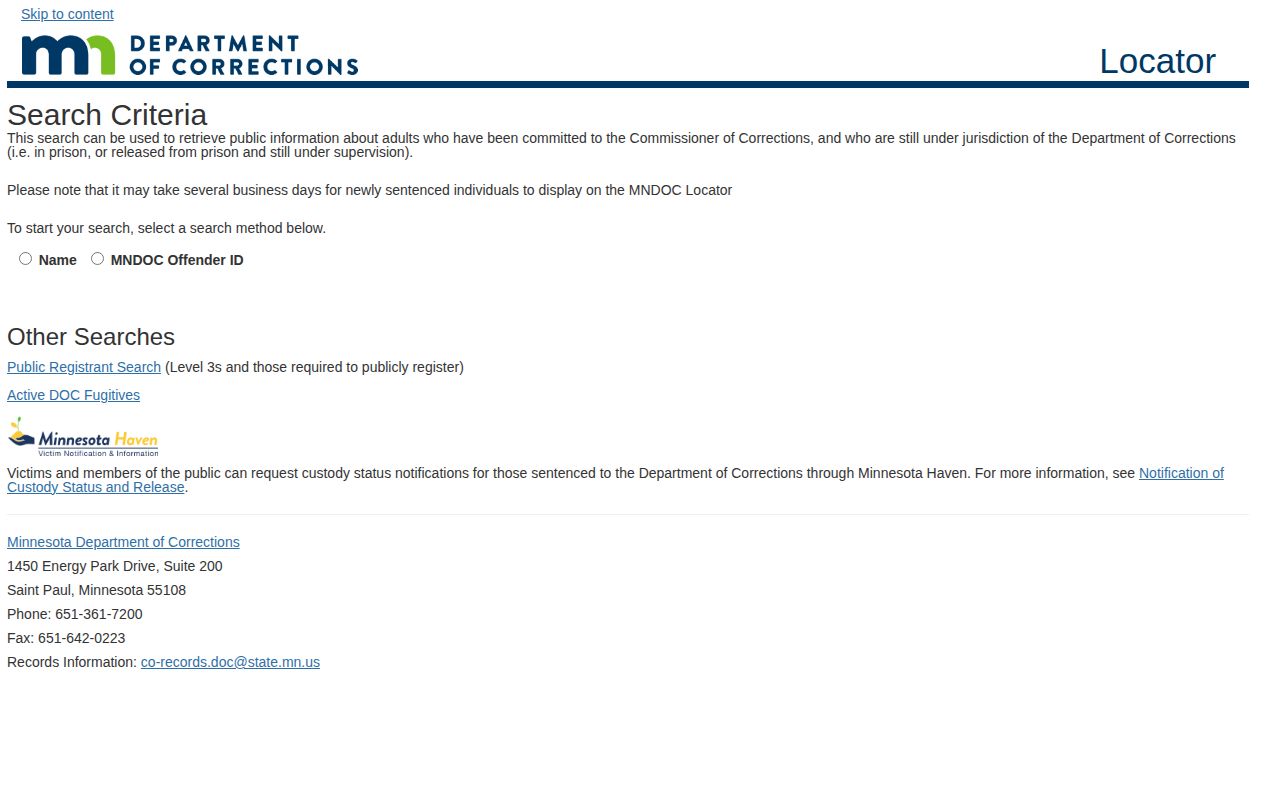
The MNDOC Locator is the official public search for an adult committed to the Commissioner. It is not a Lincoln County booking archive. Search a person only when the case became a state sentence or DOC supervision is plausible.
- Open the MNDOC public viewer and search by name or six-digit MNDOC ID.
- Open the detail instead of relying on the result row.
- Match the court file number to the Lincoln County case.
- Read Current Status before any date field.
- Treat Anticipated Release Date as prospective and Expiration Date as the sentence endpoint.
- Ask the listed caseworker, facility, or central records office to explain a conflict.
The official search form appears in the Minnesota DOC public viewer.
The viewer concerns state prison custody and supervision, not a person released after a county-only jail stay.
The Lincoln County release search covers the earlier jail and court records when a person has not entered MNDOC custody.
Minnesota DOC Release Record Fields
A typical public detail contains identity, sentence, status, and case links. Fields vary by record, so use the labels actually displayed.
| Field | Meaning |
|---|---|
| MNDOC ID, DOC name, aliases | Primary identity match |
| Current Status | Incarceration, supervision, placement, or discharge wording |
| Sentence Date | Date associated with the DOC sentence record |
| Anticipated Release Date | Projected transition from prison custody |
| Expiration Date | Recorded sentence endpoint |
| Caseworker or agency | Official supervision contact when displayed |
| Offense and court file | Links the DOC record to the correct court case |
Newly sentenced people can take several business days to appear. A no-result can also reflect final discharge or matching limits, so use the court file and records request for older history.
Name results use prefix matching across names associated with the DOC record. A six-digit MNDOC ID is the stronger key when it is known. A supervised detail can identify the supervising agency and agent, while an incarcerated detail may show the Anticipated Release Date. Never merge those two record states.
Minnesota DOC Release Contacts
The public Locator should be the first stop. For detailed sentence or release questions, use the facility or caseworker named in the record, or contact central records with the MNDOC ID and court file. General MNDOC contact information serves state cases, not a routine Lincoln County jail booking.
1450 Energy Park Drive, Suite 200
St. Paul, MN 55108
651-361-7200
Central records: co-records.doc@state.mn.us
The MNDOC data-request page is the formal path for public state correctional data. Ask for an existing public sentence explanation, release event, or discharge record. Minn. Stat. § 241.06 requires the inmate record to include discharge date, whether final, condition on leaving, and transfers, subject to its access rules.
A useful request identifies the MNDOC ID, the Lincoln County court file, and the precise field that needs explanation. Ask whether the record shows prison release, supervised release, another placement, or final discharge. These terms mark different stages. Requesting an existing record also avoids asking staff to calculate a new projected date or create a custom account.
Minnesota DOC Release Sentence Split
Minnesota does not use the common 85-percent shorthand for its standard covered felony sentence. Minn. Stat. § 244.101 generally divides qualifying post-August 1, 1993 executed sentences into two-thirds imprisonment and one-third supervised release. For a simplified 36-month example, that baseline is 24 months imprisonment and 12 months supervised release before individual adjustments.
The formula is not a personal calculator. Jail credit, consecutive or concurrent cases, discipline, special conditional terms, holds, offense date, sentence corrections, and approved plans can change the actual path. Section 244.44 permits earned incentive release credit within statutory limits, while section 244.45 excludes specified sentence groups. The current statute caps the qualifying credit subtracted from imprisonment and does not allow it to reduce imprisonment below one-half of the executed sentence. MNDOC must apply the governing record and effective dates.
Minnesota DOC Release Dates
Anticipated Release Date estimates the expected transition from prison. Expiration Date ordinarily lies later because supervision can continue in the community. Physical release, supervised release, conditional release, and final discharge are distinct events. A court sentence date is different again.
| Date or status | Question answered |
|---|---|
| Anticipated Release Date | When prison release is currently expected |
| Current Status | What MNDOC reports now |
| Under Supervision as of | When a displayed community status began |
| Expiration Date | When the sentence record is expected to end |
| Actual discharge record | Whether DOC jurisdiction finally ended |
An anticipated date can move after sentence corrections, jail-credit review, discipline, earned incentive credit, concurrent or consecutive case changes, holds, or release-plan decisions where law permits. On or after that date, open the record again and read Current Status. A future or past estimate cannot replace the actual release event.
Minnesota DOC Release Notifications
Minnesota uses a two-system notification structure. Minnesota VINE covers county jails and detention facilities. It does not cover MNDOC prisons. Minnesota Haven, administered through MNDOC Victim Assistance, is the state-prison and community-supervision route. A VINE registration made during a Lincoln County booking should not be assumed to migrate after commitment.
Minnesota Haven can provide qualifying notices about DOC release stages, agent assignment, and sentence expiration under its process. Contact MNDOC Victim Assistance at 1-800-657-3830 or use the official notification page. Notification is separate from the public Locator and from a certified discharge record.
Use each notice as a prompt to verify the public status. A notification can mark a custody or supervision event, but it does not explain every sentence calculation or prove final discharge. The Locator, caseworker, central records, and the court file provide the supporting record.
Minnesota DOC Supervised Releases
A supervised person has left secure prison but remains under sentence conditions. The public detail can name the supervising agency and agent. There is no open public S3 probation roster; S3 is a secure system for authorized partners. Verify through the locator, the sentencing court, and the named office.
MNDOC's active-fugitive search is narrower still. It concerns people alleged to be evading authorities while under DOC jurisdiction. Absence there does not prove that no warrant or supervision issue exists. The Hearings and Release Unit handles release conditions, warrants, detention, and revocation functions. Eligible life and older indeterminate cases may instead involve the Supervised Release Board's review schedule and minutes.
Final discharge is another step. The Locator is not a permanent archive of fully discharged determinate sentences. If a name disappears after DOC jurisdiction ends, use the court file and an MNDOC data request for history rather than assuming the sentence record never existed.
Lincoln County to DOC Transfers
The Lincoln County Jail's custody entry should identify a transfer when a person is delivered into state custody. That is not a community release. Match the jail record, sentencing order, and later MNDOC detail using the court file number. The county record establishes when Lincoln County custody ended; the state record establishes what happened after intake.
No Minnesota state prison is located in Lincoln County. The phrase “Minnesota DOC facilities” therefore describes the statewide system serving Lincoln County sentences, not a local prison campus. Facility-specific questions should go to the institution or caseworker displayed on the matched DOC record.
A county VINE registration does not follow the person into DOC automatically. Minnesota Haven is the notification route for prison custody and community supervision. When the transfer record points to MNDOC, register through the state notification process and use Current Status to verify the later custody stage.